Your author bio is the short piece of writing that lives on your website's About the Author page, your homepage, and your book jacket. Most authors treat writing it like a chore. They draft it once, cringe at every word, paste it into seventeen different places, and never look at it again. The result reads like a Wikipedia stub written by someone who vaguely remembers meeting you at a party.
Your website bio is doing more work than you think. It's the thing a podcast host reads before your interview. It's the paragraph a bookstore prints in their event flyer. It's the page a reader visits after finishing your book to find out if you're the kind of person they want to follow. Get it right, and it quietly opens doors for years. Get it wrong, and it just sits there, being forgettable. A weak bio is one of the most common author website mistakes we see. This guide walks through both versions you need, with a formula, sample bios, and about the author page examples from real writers.
You need two bios, not one
Here's what most authors miss: you don't write one bio. You write two. They serve completely different purposes, and trying to make one version do both jobs is how you end up with something that works for nobody.
The short bio is third person, two to three sentences, and purely functional. It's the one a journalist pastes into an article. The one an event organizer reads aloud before you walk on stage. The one that goes on the back flap of your book. It states who you are, what you've written, and one memorable detail. That's it.
The long bio is first person, two to three paragraphs, and conversational. This is your About page. It's also a key factor in your author website SEO, since Google uses the text on your About page to understand who you are. It's where readers go when they've already decided they're interested and want to know more. It can be warm, funny, specific, a little weird. It should sound like you talking, not like someone else describing you in a press release.
The short one gets copied and pasted by strangers. The long one gets read by people who might become fans. Both matter. Neither can do the other's job.
The short bio formula
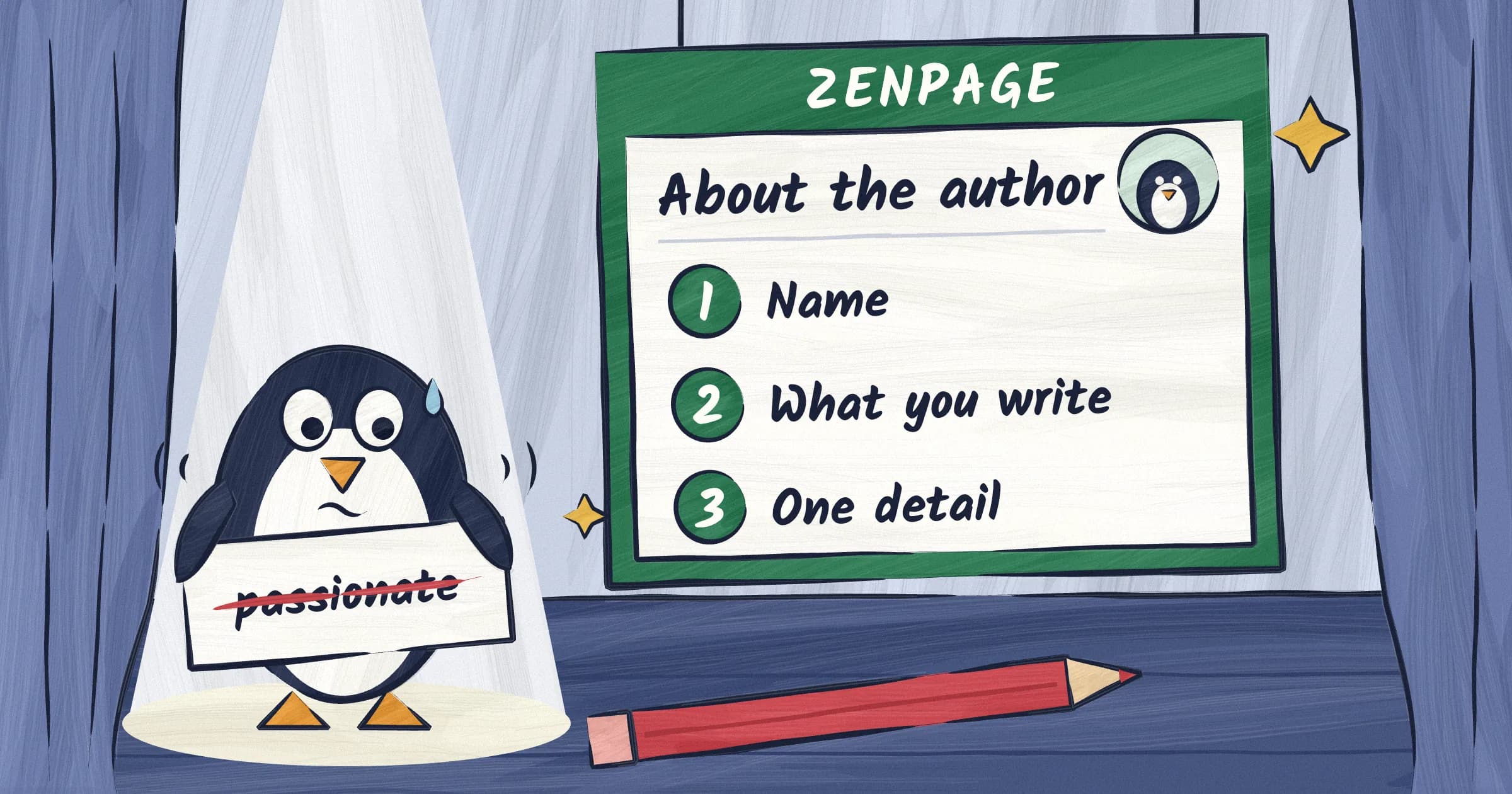
The short bio has a structure, and it's not complicated. Three sentences, each with a clear purpose.
Sentence one: Your name and your most notable credential. Sentence two: What you write or what your professional background is. Sentence three: Something personal, usually where you live, sometimes something small and human.
Here's the template: [Name] is the [bestselling/award-winning/debut] author of [Book Title]. [What they write or their background]. [Where they live or something personal].
Three examples.
"Elena Vargas is the bestselling author of The Cartographer's Daughter and its sequel, The Meridian Line. She writes historical fiction set in colonial Latin America, drawing on her background in archival research. She lives in Mexico City with two cats and an unreasonable number of maps."
"David Osei is the award-winning author of When the Light Comes Back. His novels explore grief, identity, and the immigrant experience in contemporary Britain. He lives in South London and teaches creative writing at Goldsmiths."
"Maren Lund is a debut author whose first novel, Frost Country, was longlisted for the National Book Award. She writes literary fiction about isolation, landscape, and the American Midwest. She lives in a small town in Minnesota that looks suspiciously like the one in her book."
Notice what's missing from all three. No list of every book they've published. No string of awards. No "passionate storyteller" language. Just clean, specific facts arranged in a way that gives you a picture of who this person is in under ten seconds.
The long bio: what to include
Your About the Author page is the one place on your website where readers expect to hear your actual voice. Not your publicist's voice. Not your jacket-copy voice. Yours.
Start with what you write and why it matters to you. Not a genre label, but a real answer. "I write about people who stay in places everyone else leaves" is more interesting than "I write literary fiction." One sentence, maybe two, that tells a reader what to expect from your work.
Then, briefly, what led you to writing. Briefly. Two sentences maximum. Nobody needs your origin story. They don't need to know you wrote your first poem at age seven or that your third-grade teacher said you had a gift. Pick the one detail that actually matters, the thing that connects your life to the kind of books you write, and leave the rest out.
Add one or two personal details that make you a person instead of a brand. Your dog. Your tea obsession. The fact that you lived in Japan for three years and it changed how you think about silence. These details seem small, but they're the things readers remember. They're the reason someone sends you an email that starts with "I also have a greyhound."
Mention what you're working on now. Outdated content is a reader repellent, as we covered in our author website mistakes piece. Readers who land on your About page today want to know you're still active. A sentence about your current project signals that there's more coming. It gives them a reason to stick around.
End with an invitation. Not a hard sell, not a pitch. Something like "If you want to know when the next book comes out, join my newsletter." A door, left open. The reader decides whether to walk through it.
What to leave out
Your entire publishing history. If you've written twelve books, pick the two or three that matter most and let the rest live on your Books page where they belong. You can import your full catalog with one ISBN, so every title gets its own page anyway. Your bio is not a bibliography.
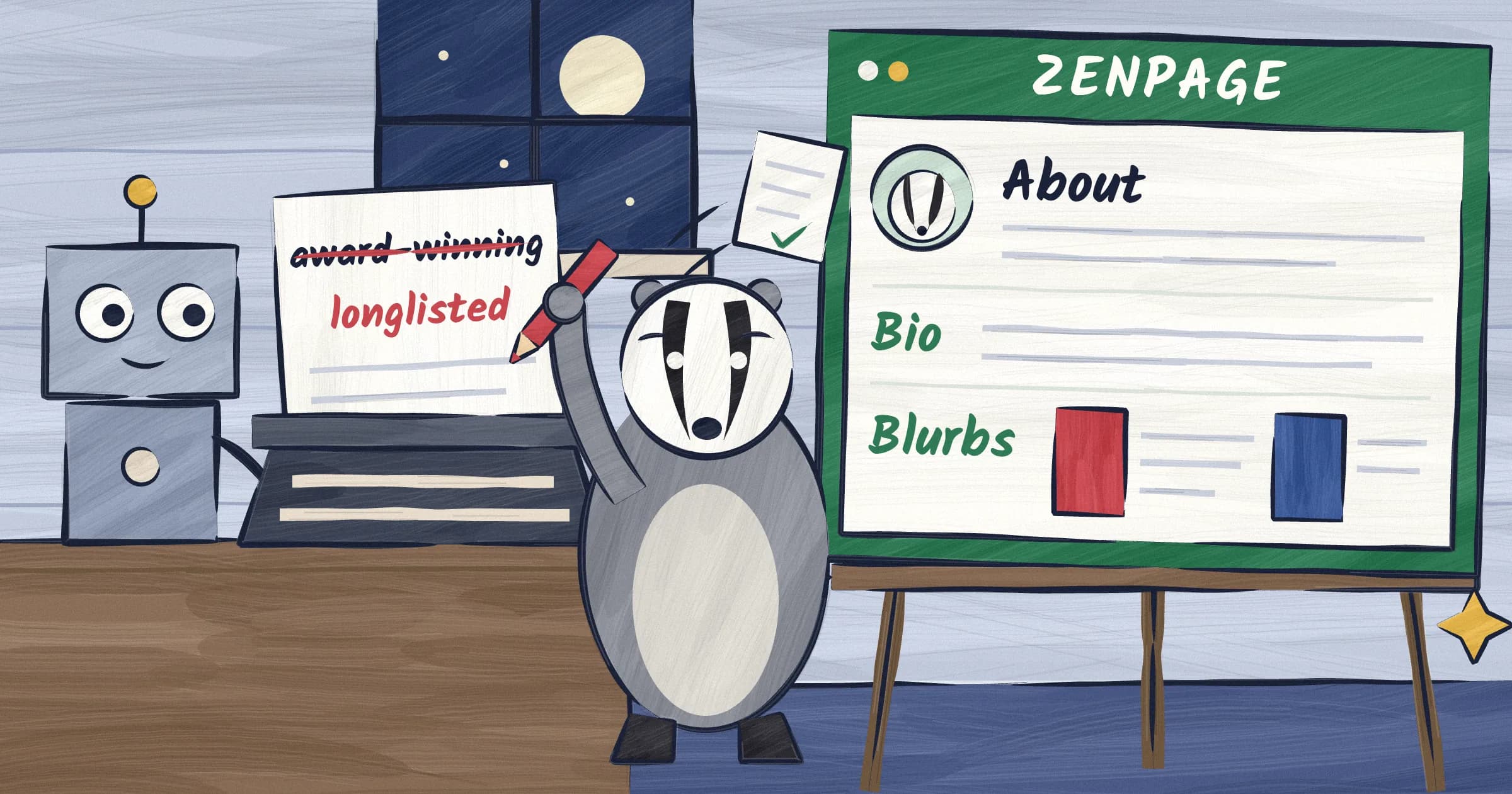
Every award you've been shortlisted for. If you won it, mention it. If you were longlisted for something most readers have never heard of, it doesn't belong here. Award lists impress other writers. They bore everyone else.
The word "passionate." Also "avid," "lifelong," and "dedicated." These words mean nothing. They're filler. Every author is passionate about writing. That's why they wrote a book. Saying it out loud adds zero information.
Anything that reads like a LinkedIn profile. "A results-driven storyteller with over fifteen years of experience in the fiction space." Nobody wants to read that. Nobody has ever finished reading that sentence and thought, "I should buy their novel."
Anything that sounds like someone else wrote it about a stranger. The test is simple: read your bio out loud. If it sounds like something a hostage would say, rewrite it. Your long bio should sound like you'd actually say these words to someone at dinner. Your short bio should sound like what a smart friend would say about you to a stranger.
About the author page examples: 3 real bios that work (and why)
Theory is fine. Examples are better. Here are three about the author pages from well-known writers, each taking a different approach, all of them effective.
James Clear
His About page opens with: "Hi, I'm James Clear."
Four words. No credentials, no book title, no "bestselling author of." Just a name and a greeting. The rest of the page follows the same principle: he leads with what he thinks about, not what he's accomplished. The book sales and the newsletter subscriber count show up later, almost as evidence rather than the point. It works because it mirrors how Clear thinks about his own work. He's not selling you a résumé. He's inviting you into a way of thinking. The credentials land harder because he didn't lead with them.
Neil Gaiman
His biography opens with: "Neil Gaiman was born in Hampshire, UK, and now lives in the United States near Minneapolis."
It's a third-person bio, but it doesn't feel stiff. The sentence is grounded in geography, not achievement. From there, it moves into his childhood reading habits, listing the authors he devoured as a kid. Before you learn what Gaiman has written, you learn what he read. That's a subtle but smart choice. It tells you he's a reader first, which is exactly what his audience wants to hear. The bio reads like a story about someone becoming a writer, not a list of things a writer has done.
Rebecca Solnit
Her site opens with: "Rebecca Solnit is the author of more than 25 books, including Orwell's Roses, Hope in the Dark, Men Explain Things to Me, A Paradise Built in Hell, and A Field Guide to Getting Lost."
This one breaks my earlier advice about not listing your entire catalog, and it works anyway. Why? Because the titles themselves do the heavy lifting. They're vivid, specific, and they span a range that makes you curious about what kind of mind produced all of them. Solnit doesn't need to tell you she's interesting. The book titles do it for her. If your titles are that evocative, lean on them. If they're not, use a different strategy.
Three very different approaches. All effective. For more inspiration, check out our round-up of the best author websites of 2026. The common thread is specificity. None of these bios waste a single sentence on vague self-description. Every word does a job. If you take one thing from these examples, let it be this: the best bios make you curious about the person, not impressed by their credentials.
Where your bio goes on your site
The About the Author page is the obvious home for your long bio. But your website bio shouldn't live in just one place.
Your homepage needs a shorter version. One to two sentences, maximum. Good author website design places this prominently so visitors immediately know whose site they're on. Enough for a first-time visitor to understand who you are and what you write without scrolling to a separate page. Think of it as the answer to "who is this person?" for someone who landed here from a Google search and will leave in eight seconds if they don't see something relevant.
Your footer or sidebar can carry an even shorter version. One line. Your name, your genre, maybe your location. This shows up on every page of your site, which means it quietly reinforces your identity no matter where a reader enters. It's a small detail, but it means a reader who lands on a blog post from Google still knows whose site they're on without scrolling back to the top.
Consistency matters. Your short bio on your homepage, your footer line, and your full About page bio should all feel like they were written by the same person. If your About page is warm and funny but your homepage bio is stiff and corporate, something's off. Pick a tone and stick with it across every surface.
If you're not sure which pages your site needs, our author website checklist walks through the full list. And if you want to see how different templates handle the About section, it's worth browsing a few before you commit to a layout.
Now build the rest
Writing your bio is the hardest part of building an author website. (Still on the fence about whether authors need a website at all? Short answer: yes.) Everything else is easier. Book covers upload in seconds. Color schemes take one click. Your homepage arranges itself. If you want to see the look and feel before committing, browse our templates.
Once you've written your bio, building the rest of your site takes 15 minutes. Zenpage is free, built specifically for authors, and designed so the writing is the only part that requires actual thought. See our features or check the pricing to confirm it fits your needs. The rest is just clicking buttons and dragging covers into place.
Your bio is ready. Your site should be too.