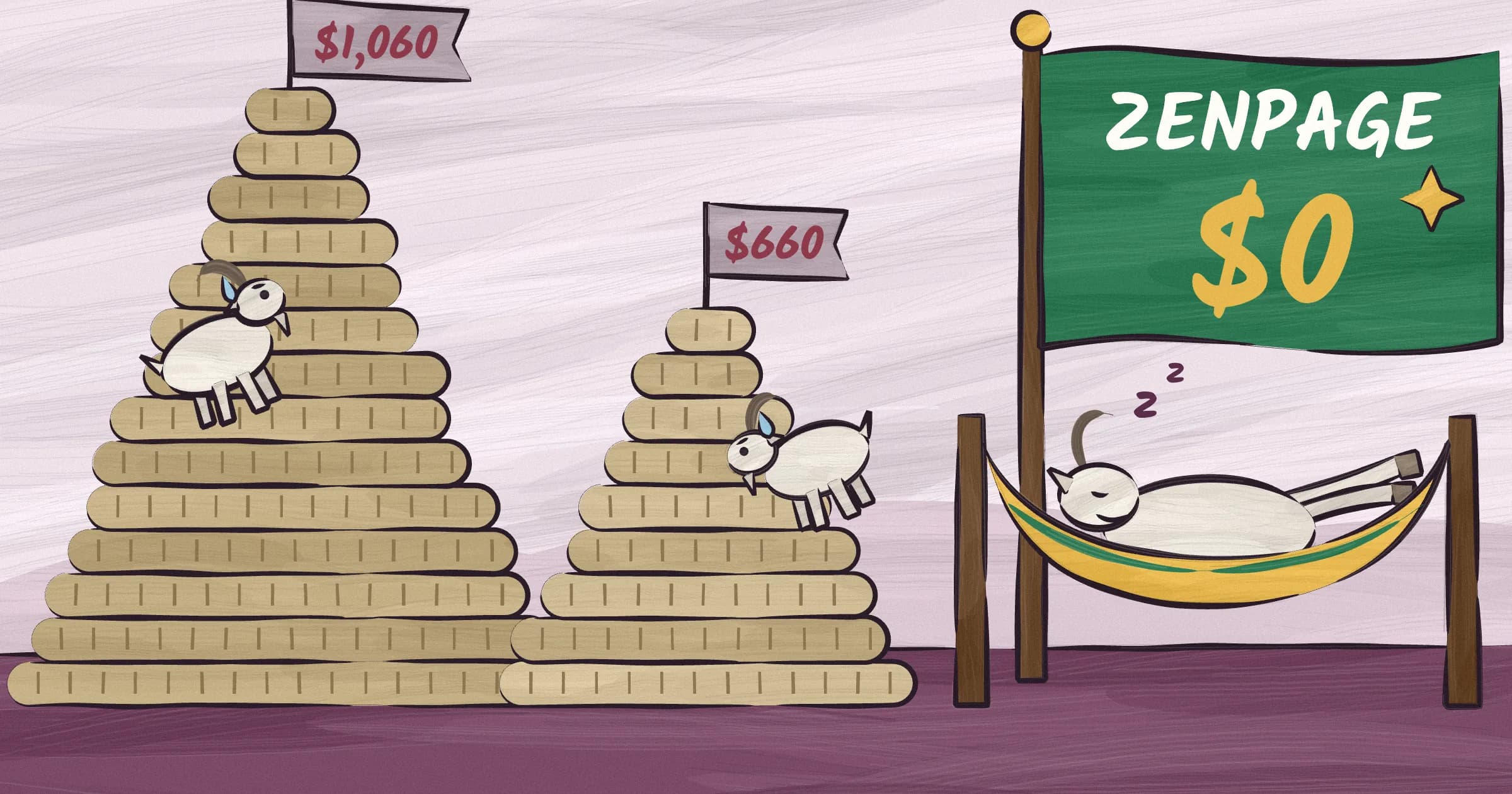
Ask Google how much an author website costs and nearly every answer comes from someone with a website to sell you. Design studios quote $1,500 to $2,500. Squarespace says $19 a month. PubSite says $20 a month. One agency's pricing guide gently suggests budgeting $3,000 to $7,000. The number moves around a lot for a question that should have a boring answer.
Full disclosure before we go further: we're Zenpage, we make a free website builder for authors, and we are exactly as biased as everyone else writing about this topic. The difference is the direction of the bias. So instead of asking you to trust our opinion, we're going to show you real renewal prices, real author income data, and real hosting costs, and let the arithmetic make the argument.
Prefer to watch? We made a 3-minute animated video that tells the short version of this story.
Here is the thesis, stated plainly. An author website is one of the cheapest things on the internet to operate, sold at prices designed for businesses, to a group of people who earn less from their books than almost anyone assumes. That is why author websites should be free. Not cheap. Free.
What an author website costs in 2026
If you've started comparison shopping, you've seen the monthly prices. Ignore them. What matters is what you'll pay in year two, because year two is the price you'll pay forever. (We compared these platforms feature by feature in our author website builder comparison. This post is just about the money.)
Here's the honest table, using annual billing, which is always the cheaper path:
| Option | Advertised price | What year two actually costs |
|---|---|---|
| Squarespace Basic | $19/mo billed annually | ~$248/yr with domain |
| Wix Light | $17/mo billed annually | ~$225/yr with domain |
| WordPress.com Personal | $4/mo billed annually | ~$60/yr with domain |
| Self-hosted WordPress | $2.99-3.99/mo hosting intro | ~$120-400/yr after renewals |
| PubSite | $20/mo | ~$255/yr with domain |
| BookBub Author Websites | Free plan, or $7.99/mo Pro billed annually | $0 on the free plan, ~$111/yr for Pro with domain |
| Tertulia Basic | $7.99/mo billed annually | ~$106/yr with domain |
| Freelance designer | ~$1,000-1,650 up front | hosting and updates on top |
| Zenpage | $0 | $0, or ~$11/yr with a custom domain |
A few notes on that table. Prices are from official pricing pages and current price trackers as of September 2026, and monthly billing is always worse: Squarespace Basic jumps from $228 a year to $300 if you refuse the annual commitment. The freelancer figures aren't scare numbers either. When Written Word Media surveyed over 2,000 indie authors, the ones who paid a professional spent an average of $1,022, and Reedsy puts the average project on its own marketplace at $1,640.
Notice something about the author-specific services. PubSite and Tertulia built products just for writers, and both landed on the same conclusion: charge a subscription. BookBub now offers a free plan, but its fuller Pro plan is still a subscription. The cheapest paid author-specific plan still costs about $100 a year, every year, for as long as you want to exist online.
How much does an author website designer cost?
Most authors who hire a designer pay about $1,000 to $1,650. Written Word Media's survey put the average at $1,022, and Reedsy puts the average project on its marketplace at $1,640. Design studios quote $1,500 to $2,500 for an author site, and agencies quote $3,000 to $7,000 for a custom build with branding.
That price buys the design and the first build. It usually doesn't include:
- Hosting. A designer usually builds on WordPress, so you pay for hosting, about $120 to $400 a year after the intro rate ends.
- Updates. WordPress, its theme and its plugins need updates. You do them yourself, or you pay the designer by the hour.
- Changes. A new book, a new cover or a new event means an email to the designer and an invoice, unless you learn the editor.
Expect a few weeks from the first call to launch, because the designer needs your copy, photos and feedback at each step.
A designer is worth the money when you need something no template does: a members' area, a large store, or a brand built across many books and products. If you need book pages, a bio, a signup form and buy links, a template gets you the same result on day one, and you can put the $1,000 into a cover or an edit instead.
The pricing tricks to watch for
The advertised price and the real price are rarely the same number. Four patterns account for most of the gap.
The intro rate. Bluehost's famous $3.99 a month requires paying 36 months up front, about $144, and then renews at $9.99 a month. SiteGround's $2.99 plan renews at $17.99 a month, a 6x increase for the same service. The teaser rate is a customer acquisition cost. The renewal rate is the business model.
The free domain. Most annual plans include a domain for exactly one year. Then Wix renews it at around $21, Squarespace at $20, GoDaddy at about $23. An at-cost registrar like Cloudflare charges about $10.50 for the same .com. Same domain, same DNS, roughly double the price for the convenience of not thinking about it.
The shrinking free tier. Mailchimp's free plan once held 2,000 contacts. It now holds 250, and the paid tier starts at $13 a month. MailerLite cut its free tier from 1,000 subscribers to 500 in 2025, then to 250 in 2026. The pattern is consistent: free tiers exist to be reduced once you've built your list inside them. (Kit is a rare exception, free to 10,000 subscribers with their branding. Zenpage connects to six newsletter providers so you can pick whichever deal survives.)
The transaction fee. Squarespace Basic takes 2% of everything you sell on top of card processing fees. Gumroad takes 10% plus 50 cents per sale. Payhip's free plan takes 5%. Selling ebooks directly to readers is the best margin in publishing, and a platform fee quietly converts your best channel into someone else's revenue stream. (This one we take personally: Zenpage lets you sell ebooks with zero commission. Stripe's processing fee is the only cut, and it goes to Stripe.)
What authors actually earn
Now the other side of the ledger, which the pricing pages never mention.
The Authors Guild runs the largest income survey in American publishing. The most recent full survey, covering 5,699 published authors, found that the median book income for all published authors was $2,000 a year. Including speaking, teaching, and other author-related work, the median was $5,000. Full-time authors did better, with a median of $10,000 from books, and even that figure is down about 42% since 2009.
Self-publishing skews harder. The figure cited across the industry, from Alliance of Independent Authors data, is that roughly 75% of self-published authors earn under $1,000 a year from their books.
Traditional publishing doesn't rescue the math either. A typical debut advance runs $5,000 to $15,000, paid out in installments over years, and the average traditionally published book sells around 3,000 copies in its lifetime, only 250 to 300 of them in its first year. For most authors, the advance is the income.
None of this is a reason to quit writing. It's context for a purchasing decision. Most authors write around a day job not because they lack ambition but because the economics demand it, and the tools they're told to buy should be priced against that reality, not against a restaurant's.
The math nobody does at checkout
Put the two previous sections next to each other and the subscription prices stop looking small.
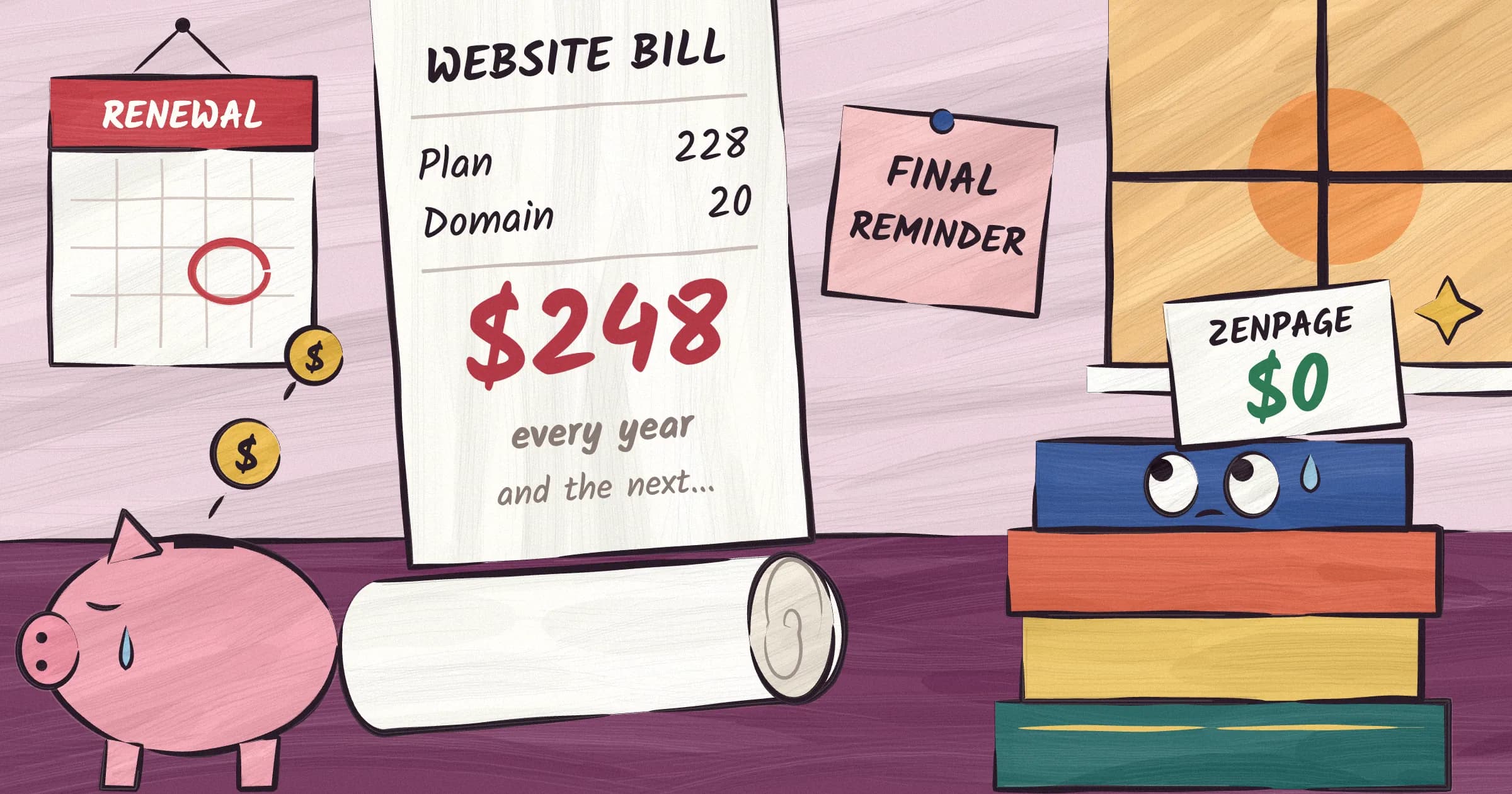
A Squarespace Basic site with a domain costs about $248 a year. Against the median author's $2,000 in book income, that is one dollar in every eight your books earn, gone before you've paid for editing, cover design, or a single ad. Add the standard companion stack, Squarespace Core at $348 plus Mailchimp Essentials at $156 plus a domain, and you're past $520 a year, more than a quarter of the median author's book income.
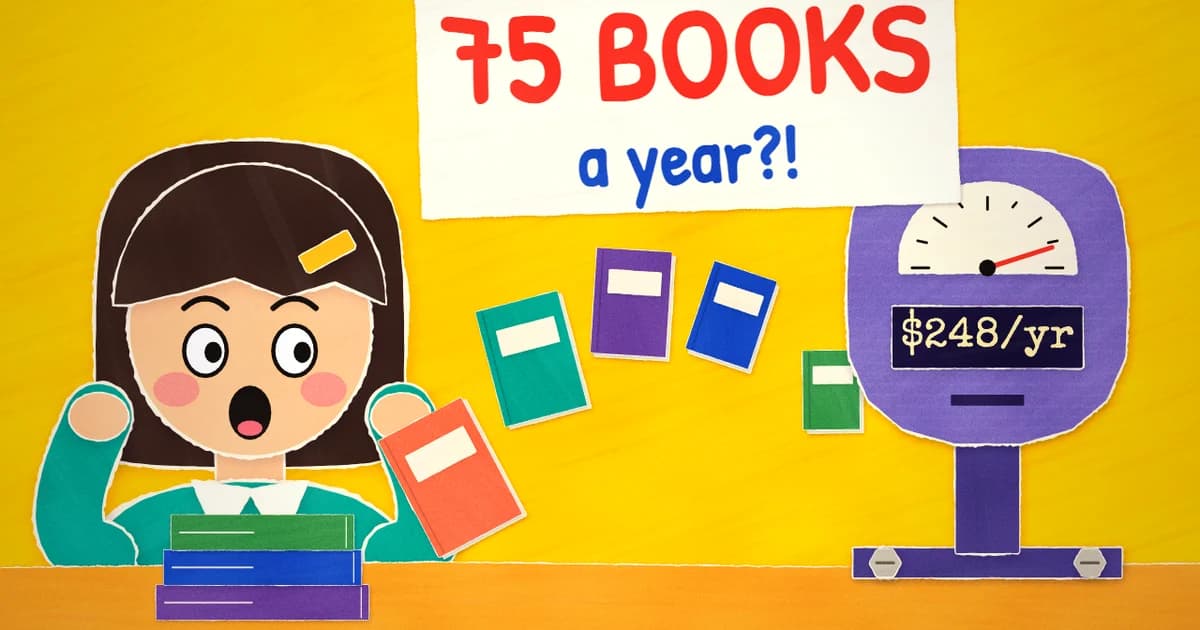
Or count it in copies. A $4.99 ebook on Amazon KDP earns about $3.30 a copy after the 70% royalty and delivery fees. At that rate, a $248 website bill costs you 75 sold copies a year, every year, before your site has paid for itself. Over five years that's more than 370 copies, which is more books than the average traditionally published title sells in its entire first year.
And for the 75% of self-published authors earning under $1,000 a year? The standard website-plus-newsletter stack can consume half their gross book income. Half, for infrastructure.
Here's the uncomfortable framing: $248 a year is genuinely nothing for a restaurant, a dentist, or a plumber. Website builders price for those customers, because those customers have revenue. Authors wandered into a store built for small businesses and got charged like small businesses. The price was never calibrated to what a writer earns, and nobody in the industry has much incentive to point that out.
What it costs to actually run an author website
So what does the thing cost to operate? Because that's the number the subscription is supposedly covering.
An author website is a brochure site: ten or twenty pages of text, some book covers, a bio, buy links, maybe a blog. Served as static pages from a CDN, a site like that costs pennies per month. Not metaphorical pennies. Single-digit cents. There's no inventory system, no booking engine, no user accounts, nothing that requires expensive computing.
What your $200 a year actually buys is everything around the hosting: the drag-and-drop editor you'll use twice, the podcast ads, the Super Bowl commercials, the sales and support teams, and the margin a public company owes its shareholders. Those are all real costs. They're just costs of the platform's business, not costs of your website.
This is the core of the argument. The price of author websites and the cost of author websites have completely detached. When the marginal cost of serving something approaches zero, someone will eventually offer it at cost. We wrote up exactly how Zenpage stays free on our pricing page, and the summary is unexciting: static pages cost us almost nothing to host, we take no commission on ebook sales, and we'd rather have every author on the platform than a subscription fee from a fraction of them.
The catch with free author websites
Your skepticism at this point is reasonable and historically well earned. For twenty years, "free website builder" has meant ads injected into your pages, a clunky subdomain, and a "powered by" badge in your footer. We've tested the free author website builders, and the short version is that most free tiers are marketing for the paid tier. Wix's free plan puts Wix's ads on your author site. That isn't a free website. That's you hosting their billboard.
So hold any free option, ours included, to a real standard: no ads, no platform branding you can't remove, a custom domain if you want one, and no paywall in front of the things an author site exists to do, meaning book pages, a bio, a blog, newsletter signup, and SEO that works out of the box. If any of those cost extra, it's not a free website. It's a demo.
The other fair question is permanence: what happens if a free platform disappears? Ask the same question of the paid ones. Paid platforms shut down, get acquired, and raise prices too, and email tools have been quietly shrinking their free tiers for years. A subscription fee is not an insurance policy. Your actual insurance is the same in every case: register your own domain, and keep your own copies of your words. Both are portable. Both are yours.
Spend it where it sells books
The strongest argument for a free website isn't the $200 you save. It's what the $200 does somewhere else.
A website is infrastructure. Nobody buys your novel because your hosting plan was expensive. Readers care whether the site loads, whether the books are front and center, and whether there's a clear path to buy them. A $0 site that does those things beats a $2,500 custom build that doesn't, and we have seen a lot of $2,500 custom builds that don't.
Meanwhile, $200 a year buys things that measurably move books: a chunk of a professional cover, a promo newsletter slot, a modest ad experiment for your next launch. Editing, covers, and promotion compound. Hosting fees don't.
If you want to spend something on your web presence, spend about $11 a year on your own domain at an at-cost registrar. That's the entire justified infrastructure budget for an author in 2026. Everything else should be free, and now you know why we built it that way.
The honest answer
How much does an author website cost? It costs the platform pennies to host. It costs you whatever their business model requires. Those are different numbers, and the gap between them is the entire industry we compete with.
Around 85% of working authors already have a website, so the question was settled long ago (we've made that case separately if you're in the other 15%). The only question left is why anyone should keep paying rent on one. Pick a template, add your books, and be live in 15 minutes.
Questions about author website costs
How much does an author website designer cost?
Most authors pay a designer about $1,000 to $1,650 for an author website, and custom builds from agencies run $3,000 to $7,000. Hosting, about $120 to $400 a year, and updates cost extra.
How much does an author website cost per year?
From $0 to about $250 a year on a builder. Squarespace Basic costs about $248 a year with a domain, Wix Light about $225, Tertulia Basic about $106 and WordPress.com Personal about $60. Zenpage is free, and a custom domain costs about $11 a year.
Is a free author website good enough?
Yes, if it has no ads, no branding you can't remove, your own domain, book pages with buy links and a newsletter signup. We tested the free options in our author website builder comparison.